
All About the Women’s Rights Movement
Women did not always have the rights they do now. Check out this brief history of the women’s rights movement.
When Did the Women’s Rights Movement Begin?
The women’s rights movement in the US officially began in 1848 at the Seneca Falls Convention in New York.
Elizabeth Cady Stanton and Lucretia Mott organized the convention.
Both women were active in the movement to end slavery in the United States. They were barred from speaking at an anti-slavery convention in London, England because they were women.
The anti-slavery movement and the women’s rights movement grew together as they both promoted equal rights among all people, regardless of race or gender.
Three hundred people attended the Seneca Falls Convention. Elizabeth Cady Stanton wrote and read aloud a “Declaration of Sentiments.”
The Declaration of Sentiments
The Declaration of Sentiments was modeled after the Declaration of Independence.
It even started the same way (with the addition of two words): “We hold these truths to be self-evident: that all men and women are created equal…”
The Declaration of Sentiments addressed the lack of voting rights and the barriers women faced in education, employment, and leadership.
Key Figures in the Early Women’s Rights Movement
These four women played a pivotal role in propelling the early women’s rights movement.
Elizabeth Cady Stanton
Not only did Elizabeth Cady Stanton write the Declaration of Sentiments, but she also authored many other documents.
She was a principal organizer in the women’s rights movement.
Lucretia Mott
Lucretia Mott was a Quaker who was active in both the anti-slavery and women’s rights movements.
Sojourner Truth
A powerful speaker, Sojourner Truth advocated for the abolition of slavery and the promotion of women’s rights.
She delivered the famous “Ain’t I a Woman?” speech in 1851.
Susan B. Anthony
Susan B. Anthony joined the women’s rights movement in 1850 and became an effective organizer.
Like Lucretia Mott, she was also a Quaker who worked to end slavery and promote women’s rights.
Fighting for Women’s Right to Vote
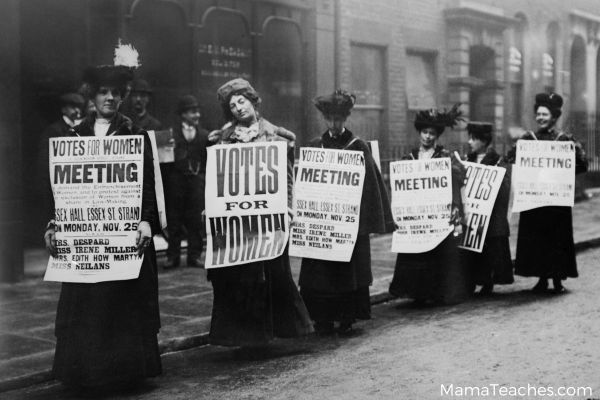
The women’s rights movement focused on suffrage, or the right to vote.
With the power to vote, women could effect more change in laws on the state and federal levels.
In 1890, the two central women’s suffrage associations merged to form the National American Woman Suffrage Association, also known as NAWSA.
NAWSA focused on changing both state and federal laws.
It was long and difficult work. NAWSA organized lectures, petitions, marches, and political lobbying.
Although a few states granted women the right to vote, such as Colorado and Wyoming, there was no national law.
In 1916, the National Women’s Party, led by Alice Paul and Lucy Burns, joined the fight. They picketed in front of the White House; they were the first group to do so!
The 19th Amendment
During World War I, women took over many traditionally male jobs since men were fighting the war.
They argued that if they were supporting the country, they deserved the right to vote. This tipped the balance.
The 19th Amendment passed Congress, and President Woodrow Wilson signed it in August of 1919.
As an amendment to the Constitution, it must be ratified by 3/4 of the states. This was completed by August 1920.
The 19th Amendment states that “The right of citizens of the United States to vote shall not be denied or abridged by the United States or by any State on account of sex.”
This text gave women the right to vote. It means that no government, local, state, or federal, can deny or limit someone’s right to vote because they are a woman.
Women’s Rights Movement Today
The women’s rights movement continued past the suffrage movement.
The National Organization for Women (NOW), founded in 1966, campaigned for the Equal Pay Act, which was passed in 1963, to address gender discrimination in employment and pay.
NOW was also instrumental in the passage of Title IX (in 1972), which addressed gender discrimination in education.
The women’s rights movement is still active today, focusing on issues that affect women.
Its goals are evolving to address the challenges that women face today.