Homeschool STEM Time! Make an Easy Potato Clock
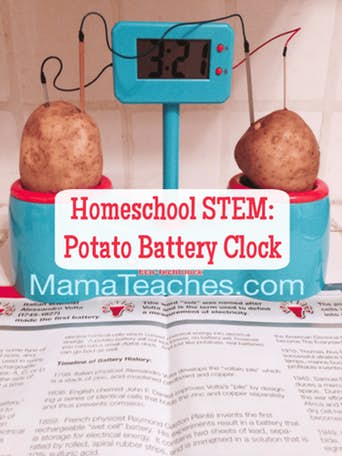
So, when Super G got a potato clock kit as an early Christmas gift, you know we had to try it out within the first 24 hours. In fact, Super G was the one who couldn’t wait to break open the kit and find some potatoes.
We followed the directions, hooked up the potatoes and the clock and ta-da! a potato clock was made. But, how and why does it actually work? That took a bit more investigating.
When you connect your potatoes to the digital clock, you use a copper wire/stick. There is then a zinc stick that’s inserted about 2cm away from the copper. Here’s where it gets really interesting. The ions in the zinc and the ions in the copper react with one another and the potato is used as a buffer. Basically, the potato becomes an electrochemical battery that changes the chemical reaction into electric energy that powers the digital clock.
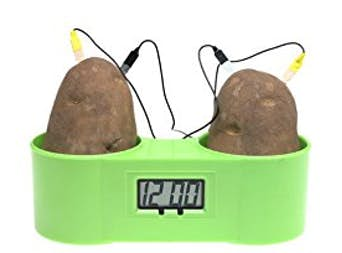
So, wouldn’t the zinc and the copper create a reaction without the potato? Absolutely, but it would just create heat. The presence of the potato changes all of that and makes the electrons have to use the copper wires to do all of that transferring of energy. When those electrons bounce around the copper wires, it creates the electrical energy needed for the clock to function.
Potatoes aren’t the only buffers that can be used when creating electrochemical batteries. In fact, lemons are another common food that are often used. After our potato battery eventually stops working, we plan on testing with a lemon and seeing which one lasts the longest. We’re hypothesizing that the lemon will because it’s more acidic, but we’ll have to test that theory.
For more battery learning and fun, check out the two books below. They’re sure to be energizing! (Sorry, I couldn’t resist.)
BOOKS:
Batteries, Bulbs, and Wires by David Glover
Klutz Battery Science Make Widgets That Work and Gadgets That Go