10 Ways Thrifting Clothes Can Teach Kids About Math
Thrifting clothes can land you more than a great deal; it can also be a math lesson!
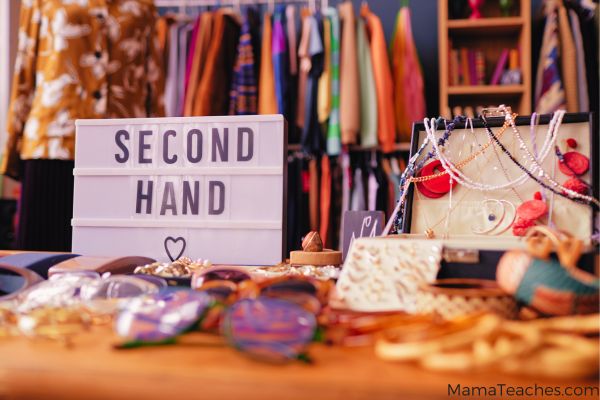
Teaching Math at a Thrift Store
A thrift store provides you with a math playground.
Brings Math into Real Life
Kids lose interest in math because they fail to see the real-life application of what they are learning.
Perhaps you have heard this question: “When will I use this?”
Thrift stores make math utterly real.
When kids see the purpose of math (in this case, purchasing items), they are more willing to learn it.
Allow You to Shop Without Breaking the Bank
A thrift store is not the only retail space in town, but it is definitely the most affordable.
You can buy multiple items (cue the addition and multiplication) without spending much money.
Has Multi-Age Appeal
A thrift store is a magical land of randomness. There is something for every age.
Whether your child is six or sixteen, a thrift store will have something of interest.
No Pressure to Buy
A thrift store is a zero-pressure sales environment; no one works on commission.
You can head in for a math lesson and then head out empty-handed–without receiving any glares from the sales staff.
10 Math Activities for the Thrift Store
Check out these ten math lessons you can do at a thrift store.
Budgeting (Addition)
Give each child a set amount (say, $20), and have them select items whose total will not exceed the amount.
Buying Multiples (Multiplication)
Forget flashcards. Travel around the thrift store, rounding the types of items to the nearest whole number.
Let’s say T-shirts are $6. Ask your child, “How much will you spend if you buy 2 T-shirts? What is 6×2?”
You can practice times tables with real-life items.
Calculating Cost Per Wear (Division)
Find the pricier items in the thrift store. These may be fancy dresses, shoes, jewelry, accessories, or small kitchen appliances.
Round the price to the nearest whole number.
Practice basic division by asking your child to determine the cost per wear/use.
For example, “This sequined dress costs $30. If you wore it three times, how much would each time of wearing cost you?”
Pattern Recognition
The clothes in a thrift store are sorted by gender, type (pants, long-sleeved shirts, dresses, etc.), and size.
Some thrift stores may go further and sort by color as well.
If they do not sort by color, park yourselves in a size section and create a pattern of colors. See if your child can detect and replicate the pattern.
Price Comparison Chart
How much money does thrifting save? Make a price comparison chart and find out.
Have your older student create a table (or use a spreadsheet program) with the price of a thrifted item and that same item online.
You can do a basic comparison: is the thrifted item’s price greater than, less than, or equal to the online item?
You could analyze it further by calculating the percent increase or decrease.
Percents
Typically, thrift stores have discounts on certain items each week.
For example, items with a blue tag may be 50% off on a given day or week.
Students can calculate discounts before purchasing.
If your state has a sales tax, your child can also calculate the sales tax on a total purchase.
Estimating
Teach your child about estimating with thrift store prices.
You can have them round each item to the nearest dollar or ten dollars and then add.
Counting Change
Have your child pay for the thrifted items with cash so they receive actual change.
They can then count the bills and coins to verify the change on the receipt (ask the cashier not to tell the amount out loud).
Creating a Shopping List with Price Estimates
Before you go to the thrift store, ask your child to make a shopping list of what they hope to find.
Start by allocating a certain amount of money (like $20). Then your child lists items they hope to find with price estimates.
- Hoodie $12
- Belt $4
- Cool tie $4
- Total = $20
Bring the list to the thrift store and search for the items. How do their prices compare to the estimates? Make a note.
- Hoodie $10 (-$2)
- Belt $5 (+$1)
- Cool tie $3 (-$1)
- Total = $18 ($2 below budget)
Adding and Comparing Carts
When you enter the thrift store, everyone gets a cart.
Tell them they can add a certain number of items they like.
At the end, trade carts and add up the total price per cart.
Whose cart costs the most? Whose costs the least?
Thrifting Clothes Helps with Math
These ten ways you can make a math lesson from a trip to the thrift store show the educational value of thrifting!
Now this fun family pastime can be a math lesson waiting to happen!