
Executive Functioning Challenges and ADHD: What’s the Connection?
Delve into the overlap between ADHD and executive functioning challenges, and find out what you can do to help.

What Are Executive Functioning Skills?
Executive functioning skills are mental processes that help a person accomplish tasks in both the short and long term.
Essentially, executive functioning skills are the brain’s management system.
These skills include working memory, planning and organization, time management, flexible thinking, and impulse control.
For more on executive functioning skills, check out this article.
What Is ADHD?
ADHD, or Attention Deficit Hyperactivity Disorder, is a condition characterized by difficulty maintaining attention and/or controlling hyperactivity.
In the US, about 9% of children are affected by ADHD. It is twice as common in boys as in girls.
ADHD may co-occur with other conditions or learning differences, such as anxiety, dyslexia, dysgraphia, and dyscalculia.
How ADHD Connects to Executive Functioning
ADHD isn’t just about the brain’s ability to focus or control hyperactivity; it is about how the brain organizes tasks and regulates itself.
Because of these differences, children with ADHD struggle more with executive functioning tasks.
Understanding this difference can help you understand your child and provide much-needed support in gaining those executive functioning skills.
For example, if your child “forgets everything,” this may be an issue of poor working memory, not just inattentiveness.
You may tell your child to do something, only to find that thirty minutes later, they have yet to begin. This may not be laziness or even forgetfulness, but rather a struggle with task initiation (they don’t know where to start).
Common ADHD behaviors are often struggles with executive functioning skills.
How to Tell If Your Child Needs to Strengthen Executive Functioning Skills
Children (even those without ADHD) may struggle with gaining executive functioning skills. There are some tell-tale signs that this is the case.
Constantly Losing Things
As mentioned earlier, constantly losing items may be an indicator of poor working memory.
Working memory is a very short-term memory, used by the brain to problem solve, follow directions, and more.
If your child sets his backpack on a chair and then, a few minutes later, cannot find it, that may indicate poor working memory.
Struggling with Transitions
A child with a poor sense of time cannot tell how much time has elapsed. This is called time blindness.
For instance, if you say they have thirty minutes to spend at the park, they have no innate sense of how much time has elapsed.
When you tell them, “Ok, it’s time to go,” that may feel abrupt.
They were not expecting it, and so they react emotionally to that news and don’t transition well.
Difficulty Completing Tasks
Task initiation, planning, organization, and time management are all executive functioning skills that affect a person’s ability to start or complete tasks.
Becoming Easily Frustrated
It is easy to become frustrated and overwhelmed when you have a poor sense of time and difficulties with planning and organization.
Difficulty Discerning Time
A poor sense of time means not only that a person cannot sense how much time has elapsed, but also that they cannot accurately estimate how much time a task will take.
Often, what looks like procrastination is an inability to estimate how much time a task will take.
Focusing Issues
While focus is related to attention, it also means that a person may easily be diverted to a different task.
Again, this has to do with task initiation and planning, not being sure of how one task builds on to another, or the proper sequence of tasks.
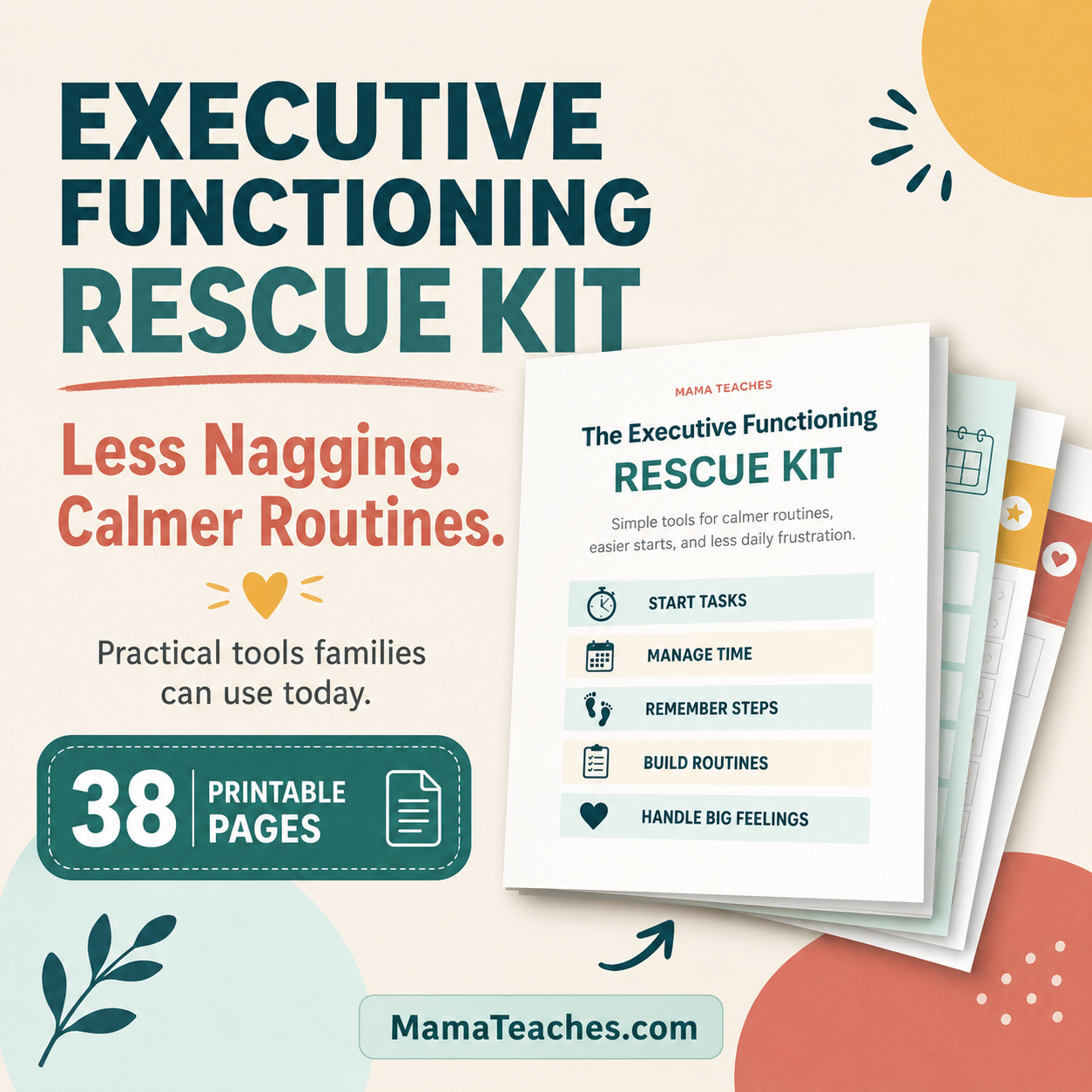
Need Help With Executive Functioning at Home?
When starting, remembering, managing time, staying organized, or handling frustration becomes difficult, the Executive Functioning Rescue Kit for Families can help. Inside, you’ll find supportive parent scripts, simple rescue strategies, and practical printable tools designed to create calmer routines with fewer repeated reminders.
How to Help Strengthen Executive Functioning Skills in Kids with ADHD
The connection between executive-functioning skills and ADHD is good news, and here’s why.
ADHD does not go away, but many of its symptoms are really shortcomings in executive functioning skills, and those can be strengthened over time.
Executive functioning skills are developmental, meaning they grow over time.
The brain does not fully mature until the mid-twenties, and many of the executive functioning skills take place in the frontal lobe, which continues to develop until that age.
In short, time helps.
That does not mean you sit around and wait. You can work on executive functioning skills with activities to shore up those skills.
You can also provide supports to make up for deficits in time management, organization, etc.
Specific Strategies and Supports to Help Kids with ADHD
These supports will help kids with ADHD strengthen their executive functioning skills.
Visual Aids
Use checklists and visual schedules to help kids move through tasks.
Visual Timers and Countdowns
Visual timers make time more concrete by showing the remaining time as a slice of a pie chart. (Time Timer even has a visual timer app.)
Use sticky notes or calendar notations to count down until important deadlines or events.
Keep Routines Consistent
Assign specific blocks of time for tasks in the daily schedule. (If you want a digital scheduling app, try Brili Routines.)
Keep the schedule as consistent as possible.
Even if you don’t do the same thing every day, use rhythm scheduling.
A rhythm schedule means one thing always follows another.
For example, when you come in from outside, you take off your shoes, wash your hands, and have a glass of water.
Chunk Tasks
Break large tasks into smaller chunks, and set individual deadlines for each little task.
When giving directions, give one instruction at a time. When the child can do this well, give two directions, but have him say the directions back to you (or to himself) before he starts.
This will help him build his working memory.
Movement Breaks
When you have ADHD, the urge to move can be intense.
By allowing some movement, the brain can focus on the executive functioning processes.
Allow your child to use fidget toys (like this DIY stress ball) during tasks that require sitting.
Or choose alternative seating, like wiggle stools.
Add in movement breaks as well to allow a breather for the mind and body.
Emotional Coaching
Help your child manage emotions by first teaching about emotions.
You can use strategies such as role-playing difficult situations and practicing mindfulness.
Understanding the Connection Between ADHD and Executive Functioning
Understanding the connection between executive functioning skills and ADHD can help you provide the support and encouragement your child needs.
Many brilliant, creative kids have ADHD and struggle with executive functioning skills.
Be patient with your child, and encourage them to be patient with themselves.
Pick one suggestion from this list of supports, and implement it for two weeks.
If it helps, wonderful! Add another every two weeks until you have a host of tools.
If the tool doesn’t help, put it back on the shelf and try something else.
Celebrate small wins and remember you are going for progress, not perfection.
With the proper support, your child can thrive!